
Absorption in the small intestineSpec 2.32
In short
The products of digestion are absorbed in the small intestine, mostly in the ileum. Its wall is covered in villi and microvilli, giving a very large surface area. Each villus has a wall one cell thick for a short diffusion distance, a capillary network that keeps a steep concentration gradient, and a lacteal that absorbs fatty acids and glycerol.
The products of digestion are absorbed in the small intestine, mostly in the ileum. The small intestine is adapted to absorb efficiently. It is long and its inner wall is folded. The wall is covered in millions of tiny finger-like projections called villi (one is a villus).
| Adaptation | How it helps absorption |
|---|---|
| Villi and microvilli (tiny projections on each surface cell) | Give a very large surface area |
| Wall (epithelium) is one cell thick | Short diffusion distance, so absorption is fast |
| Network of blood capillaries close to the surface | Carries glucose and amino acids away. This keeps a steep concentration gradient. |
| A lacteal (a lymph vessel) in the centre | Absorbs fatty acids and glycerol |
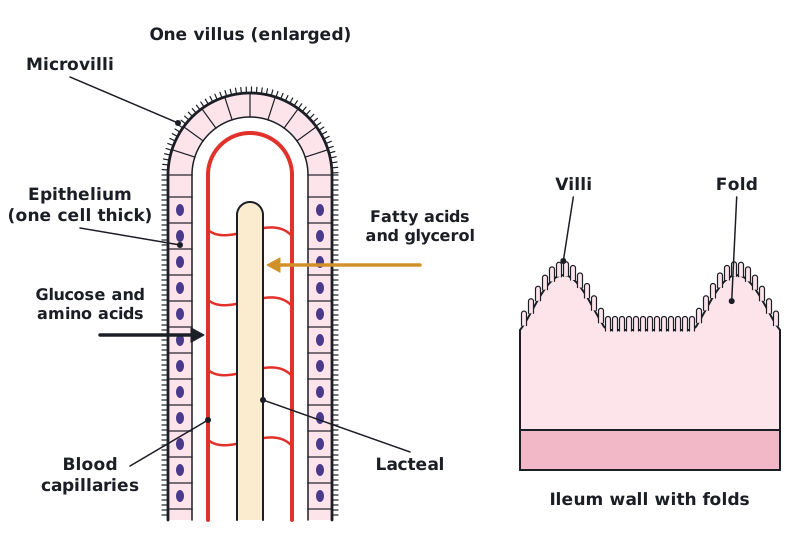 (opens full size in a new tab)
Glucose and amino acids move into the blood capillaries by diffusion and active transport. The blood carries them to the liver and then around the body. Fatty acids and glycerol move into the lacteal.
For an 'explain how it is adapted' question, give the feature and the reason: 'one cell thick, so there is a short diffusion distance'. Do not say the villi 'absorb more': say they 'increase the surface area'.
Written and checked against the Edexcel IGCSE Biology (4BI1) specification · Updated October 2026