
Practical: oxygen from a water plantSpec 2.23
In short
The rate of photosynthesis can be measured by counting the oxygen bubbles a water plant such as pondweed gives off per minute, or by collecting and measuring the volume of gas. Light intensity is changed by moving a lamp to different distances. Closer lamps give more bubbles until another factor becomes limiting. Temperature and carbon dioxide are kept constant.
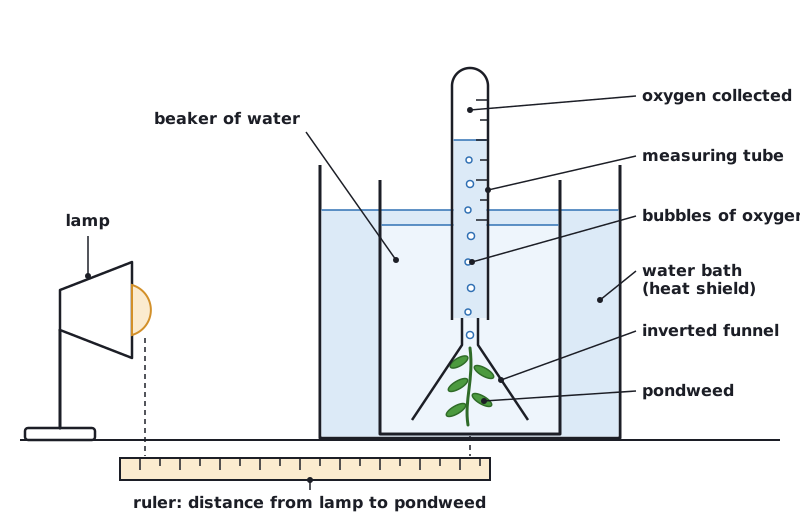
A water plant such as pondweed (Elodea or Cabomba) gives off bubbles of oxygen when it photosynthesises. Counting the bubbles, or measuring the volume of gas, gives a measure of the rate of photosynthesis. You can change the light intensity by moving a lamp to different distances from the plant.
- Set up a beaker of water with a little sodium hydrogencarbonate, which supplies carbon dioxide. Place a piece of pondweed, cut end upwards, under an inverted funnel with a test tube or measuring tube over the end.
- Place a clear container of water between the lamp and the beaker as a heat shield, or use an LED lamp, so the temperature stays constant.
- Place the lamp a measured distance from the pondweed, for example 10 cm. Switch off other light sources.
- Leave the plant for a few minutes to adjust to the new light level.
- Count the bubbles released from the cut end of the stem in one minute. Alternatively, collect the gas and measure its volume over a set time.
- Repeat at different distances, for example 20, 30, 40 and 50 cm. Repeat each distance at least three times and calculate a mean.
 (opens full size in a new tab)
| Type | Variable | How it is controlled or measured |
|---|---|---|
| Independent | Light intensity | Changed by changing the distance between the lamp and the plant |
| Dependent | Rate of photosynthesis | Number of bubbles per minute, or volume of gas collected per minute |
| Control | Temperature | Heat shield or water bath, and a lamp that gives out little heat |
| Control | Carbon dioxide concentration | Same amount of sodium hydrogencarbonate in the water each time |
| Control | The plant | Same piece of pondweed, with the same length of stem, for every distance |
Typical results: the further the lamp is from the plant, the lower the light intensity, so fewer bubbles are released per minute. The rate rises as the lamp is moved closer, then levels off when another factor becomes limiting. To show that the gas is oxygen, collect enough of it in a test tube and test it with a glowing splint, which relights.
Counting bubbles is not very accurate because bubbles can be different sizes. Collecting the gas and measuring its volume gives better data.
Safety: keep the mains lamp and its cable away from the water, and do not touch a hot lamp. Controlling temperature matters because a lamp placed close to the plant also warms the water, which would change the rate.
'Light intensity' is the independent variable, not 'the distance'. Say that the distance is how you change the light intensity.
Written and checked against the Edexcel IGCSE Biology (4BI1) specification · Updated October 2026