
RNA and protein synthesisSpec 3.17B, 3.18B
In short
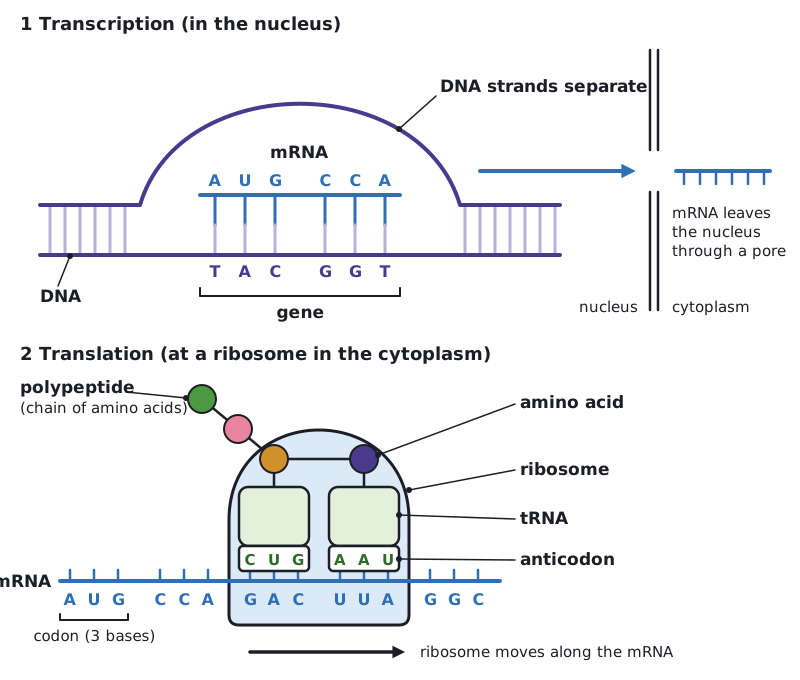
Protein synthesis is how a gene is used to make a protein. In transcription, in the nucleus, a single strand of mRNA is made as a copy of the gene by complementary base pairing, with uracil instead of thymine. In translation, at a ribosome, tRNA anticodons pair with mRNA codons, and each codon codes for one amino acid.
DNA stays in the nucleus, but proteins are made at ribosomes in the cytoplasm. A different molecule, RNA, carries the instructions from the gene to the ribosome.
| DNA | RNA | |
|---|---|---|
| Number of strands | Two (double helix) | One (single stranded) |
| Base that pairs with adenine | Thymine (T) | Uracil (U) |
| Bases present | A, T, C, G | A, U, C, G |
A codon is a sequence of three bases on mRNA. Each codon codes for one amino acid. An anticodon is a sequence of three bases on a tRNA molecule that is complementary to a codon.
Stage 1: transcription (in the nucleus)
- The two DNA strands separate along the gene.
- A single strand of mRNA (messenger RNA) is made as a copy of the gene, by pairing complementary bases. A pairs with U, T pairs with A, C pairs with G and G pairs with C.
- The mRNA leaves the nucleus through a pore and goes to a ribosome in the cytoplasm.
Stage 2: translation (at a ribosome)
- The mRNA attaches to a ribosome.
- tRNA (transfer RNA) molecules bring amino acids to the ribosome. Each tRNA carries one specific amino acid.
- The anticodon of each tRNA pairs with the matching codon on the mRNA.
- The amino acids are joined together in the order set by the codons, making a chain called a polypeptide. The polypeptide folds up to form a protein.
Transcription and translation of a short gene
The DNA template strand reads T A C G G T. Give the mRNA codons and the tRNA anticodons.
- Transcription: pair each DNA base with its RNA partner. T gives A, A gives U, C gives G, and so on. mRNA = A U G C C A.
- Codons: AUG and CCA.
- Translation: each anticodon is complementary to its codon. AUG pairs with UAC and CCA pairs with GGU.
Answer: mRNA codons AUG CCA; tRNA anticodons UAC and GGU.
 (opens full size in a new tab)
Do not mix up the two stages. Transcription makes mRNA from DNA in the nucleus. Translation makes a polypeptide from mRNA at a ribosome.
Codons are on mRNA. Anticodons are on tRNA. Name the molecule when you use either word.
Quick check
What is a gene?
Show answer
A section of a molecule of DNA that codes for a specific protein.
What is the genome?
Show answer
The entire DNA of an organism.
Biology only Which base pairs with adenine in DNA?
Show answer
Thymine.
Biology only Which base is in RNA instead of thymine?
Show answer
Uracil (U).
Biology only Where are amino acids joined together to make a polypeptide?
Show answer
At a ribosome (translation).
Written and checked against the Edexcel IGCSE Biology (4BI1) specification · Updated October 2026