
Constructing and using dichotomous keysSpec 1.2.4
In short
A dichotomous key is a series of paired statements that identifies an organism. At each step you choose between two contrasting descriptions, such as 'has fur' and 'does not have fur', and each choice sends you to another step or to the organism's name. Good keys use features that can be observed and do not change, not size.
A dichotomous key is a series of paired statements that identifies an organism. 'Dichotomous' means 'divides into two'. At each step you choose between two descriptions, and each choice sends you to another step or to the name of an organism.
Using a key
| Step | Feature | Result |
|---|---|---|
| 1a | Has feathers | Sparrow |
| 1b | Does not have feathers | Go to step 2 |
| 2a | Has fur | Rabbit |
| 2b | Does not have fur | Go to step 3 |
| 3a | Has fins | Trout |
| 3b | Does not have fins | Go to step 4 |
| 4a | Skin is dry and scaly | Lizard |
| 4b | Skin is moist and smooth | Frog |
To identify a frog, start at 1. It has no feathers (1b), so go to step 2. It has no fur (2b), so go to step 3. It has no fins (3b), so go to step 4. Its skin is moist and smooth (4b), so it is a frog.
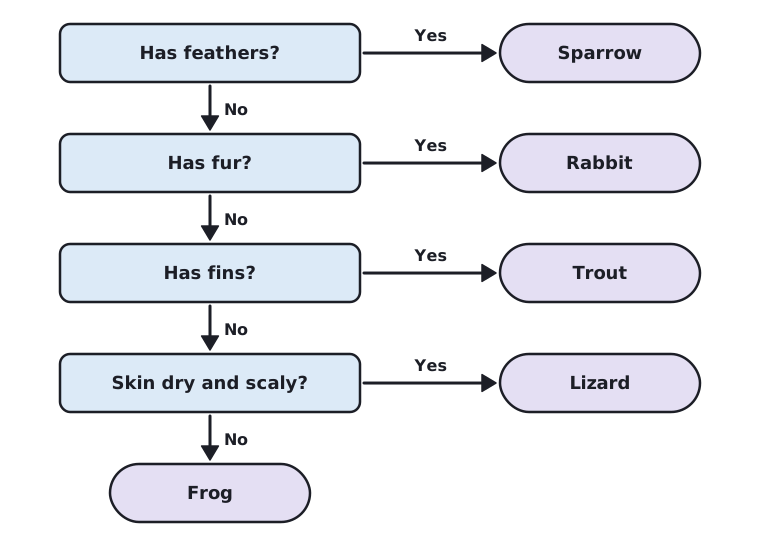 (opens full size in a new tab)
Constructing a key
- List the organisms and choose features that you can see and that are clearly different, such as feathers, fins or number of legs.
- Pick one feature that splits the organisms into two groups, so that some have it and some do not.
- Write the two statements as a pair. Each statement must be a clear contrast, for example 'has fur' and 'does not have fur'.
- Repeat with each group until every organism is on its own.
- Test the key by using it on each organism.
Use features that can be observed and do not change, such as the number of legs. Avoid size, because it varies with age. Do not use two features in one statement.
Written and checked against the Cambridge IGCSE Biology (0610) specification · Updated October 2026