
Homeostasis and negative feedbackSpec 14.4.1, 14.4.3
In short
Homeostasis is the maintenance of a constant internal environment, such as body temperature and blood glucose concentration. It is controlled by negative feedback. When a level moves away from its set point, receptors detect the change and effectors act to reverse it, so the level returns towards the set point. The response then reduces or stops.
Homeostasis is the maintenance of a constant internal environment. Cells only work well when conditions around them stay steady. Two things the body keeps steady are the body temperature and the blood glucose concentration.
- Homeostasis
- The maintenance of a constant internal environment.
Supplement (what this means)
Supplement: only for the Extended papers (2 and 4). Core students can skip it. What the labels meanNegative feedback
Supplement (what this means)
Supplement: only for the Extended papers (2 and 4). Core students can skip it. What the labels meanHomeostatic control works by negative feedback. The body has a set point, which is the normal level for the factor being controlled. If the level moves away from the set point, the body responds so that the level changes back towards the set point.
Supplement (what this means)
Supplement: only for the Extended papers (2 and 4). Core students can skip it. What the labels mean- The level of a factor (for example blood glucose) changes away from the set point.
- Receptors detect the change.
- A control system (for example the brain or the pancreas) coordinates a response.
- Effectors act to reverse the change, so the level returns towards the set point.
- When the level is back at the set point, the response is reduced or stops.
Supplement (what this means)
Supplement: only for the Extended papers (2 and 4). Core students can skip it. What the labels mean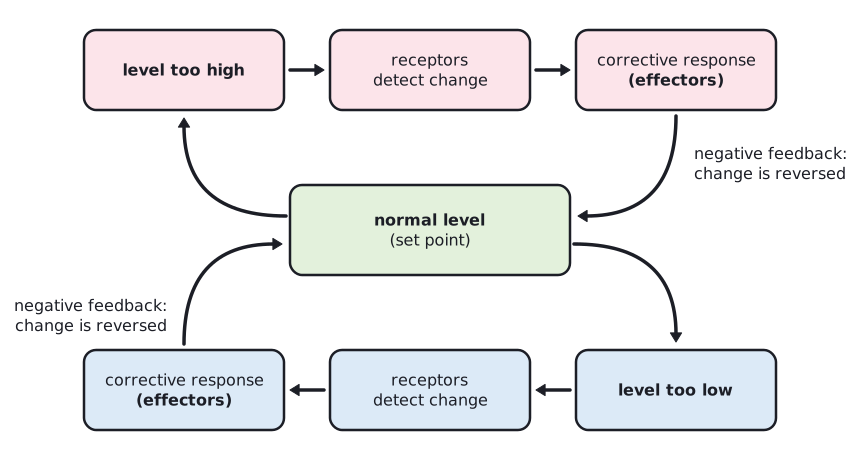 (opens full size in a new tab)
Supplement (what this means)
Supplement: only for the Extended papers (2 and 4). Core students can skip it. What the labels meanNegative feedback does not keep a level exactly fixed. The level goes slightly above and below the set point, and the response brings it back each time.
Written and checked against the Cambridge IGCSE Biology (0610) specification · Updated October 2026