
Investigating the pathway of water with a stainSpec 8.2.4
In short
Standing a cut stem in water containing a coloured stain, such as eosin or red food colouring, shows the pathway of water. After several hours, a cross-section of the stem shows the stain only in the xylem of the vascular bundles, as a ring of small dots. This shows that water travels up the stem in the xylem.
You can show where water travels in a plant by putting the cut stem in water that contains a coloured stain (dye), such as red food colouring or eosin. The stain is carried in the water, so it shows the route.
- Fill a beaker with water and add a few drops of the stain.
- Cut the base of a stem (for example celery, or a white flower) so that it has a fresh end, and stand it in the stained water.
- Leave the plant in a warm, light place for several hours, or overnight.
- Look for stain in the veins of the leaves or the petals.
- Cut a thin cross-section (transverse section) of the stem with a sharp blade and look at it with a hand lens or microscope. Cut away from your fingers.
The stain is found in the xylem. In a cross-section of the stem, only the xylem in the vascular bundles is coloured, in a ring of small dots. This shows that water travels up the stem in the xylem. In a longitudinal section, the stain appears as coloured lines.
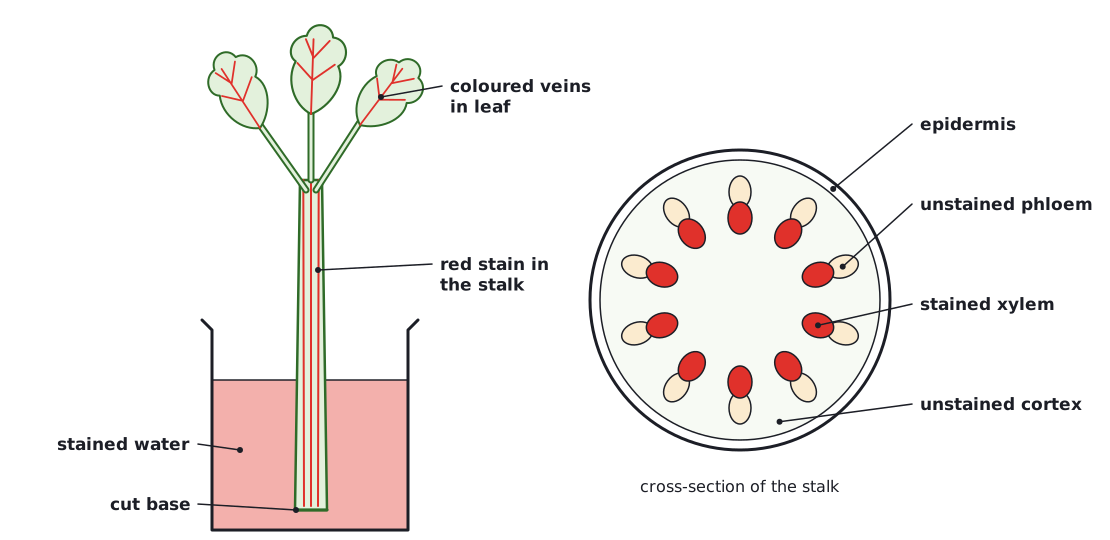 (opens full size in a new tab)
Control the variables if you are comparing plants: same type of plant, same volume and concentration of stain, same time, same light and temperature. Write what you see, not just what you expect.
Quick check
What do root hair cells absorb?
Show answer
Water and mineral ions.
Why does a root hair increase uptake?
Show answer
It gives the cell a large surface area.
Give the pathway of water in order.
Show answer
Root hair cells, root cortex cells, xylem, mesophyll cells.
Where is a stain found after a stem stands in stained water?
Show answer
In the xylem.
Written and checked against the Cambridge IGCSE Biology (0610) specification · Updated October 2026