
Pollination and fertilisationSpec 16.3.5, 16.3.6, 16.3.12
In short
Pollination is the transfer of pollen grains from an anther to a stigma, and fertilisation occurs when a pollen nucleus fuses with a nucleus in an ovule. Pollination must happen first. A pollen tube then grows from the pollen grain down through the style into an ovule, carrying the pollen nucleus to fuse with the egg cell nucleus.
Pollination is the transfer of pollen grains from an anther to a stigma. Pollination is not the same as fertilisation. Pollen has to reach the stigma first, then fertilisation can happen.
Fertilisation occurs when a pollen nucleus fuses with a nucleus in an ovule.
- Pollination
- The transfer of pollen grains from an anther to a stigma.
- Fertilisation (in plants)
- The fusion of a pollen nucleus with a nucleus in an ovule.
Supplement (what this means)
Supplement: only for the Extended papers (2 and 4). Core students can skip it. What the labels meanThe pollen tube
Supplement (what this means)
Supplement: only for the Extended papers (2 and 4). Core students can skip it. What the labels mean- A pollen grain lands on the stigma of a flower of the same species.
- A pollen tube grows out of the pollen grain and down through the style.
- The pollen tube grows towards the ovary and enters an ovule.
- The nucleus of the pollen grain (the male gamete) passes down the tube into the ovule.
- The pollen nucleus fuses with the nucleus of the egg cell in the ovule. This is fertilisation, and it forms a zygote.
Supplement (what this means)
Supplement: only for the Extended papers (2 and 4). Core students can skip it. What the labels meanYou do not need to know how the endosperm is made or how the seed and fruit develop.
Supplement (what this means)
Supplement: only for the Extended papers (2 and 4). Core students can skip it. What the labels mean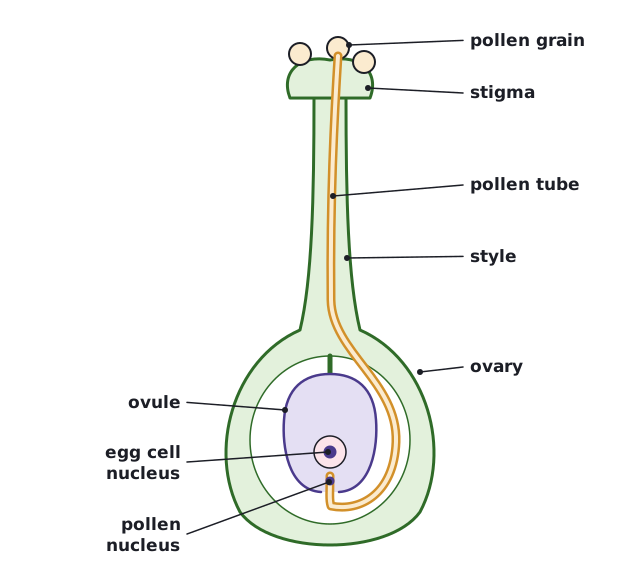 (opens full size in a new tab)
Pollination and fertilisation are different. Pollination is the transfer of pollen to the stigma. Fertilisation is the fusion of nuclei.
Written and checked against the Cambridge IGCSE Biology (0610) specification · Updated October 2026