
The nitrogen cycleSpec 19.3.2, 19.3.3
In short
The nitrogen cycle moves nitrogen between the air, the soil and living things. Decomposers break down proteins and urea into ammonium ions, and nitrifying bacteria change these into nitrate ions that plants absorb to make amino acids. Nitrogen fixation by bacteria and lightning turns nitrogen gas into usable compounds, while denitrifying bacteria turn nitrates back into nitrogen gas.
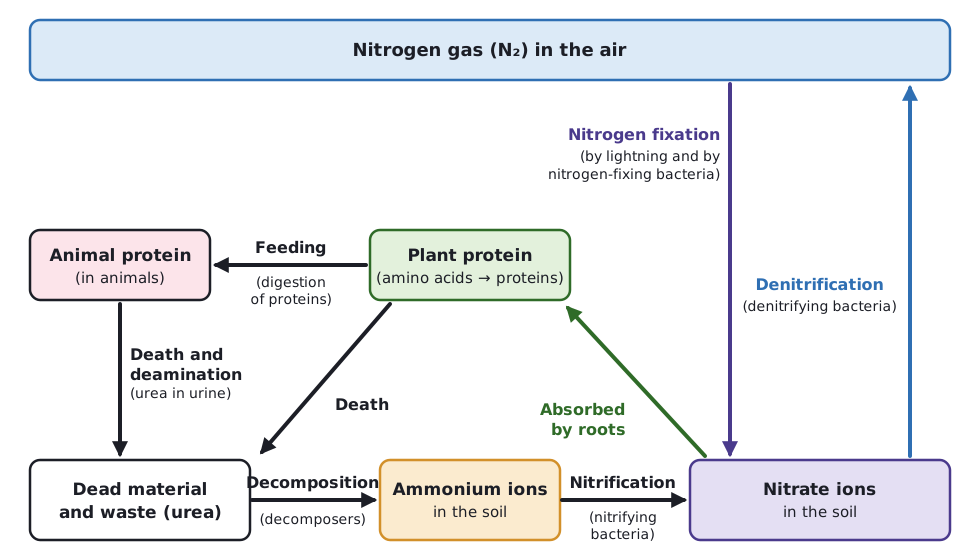
Plants need nitrogen to make amino acids and then proteins. Nitrogen gas makes up most of the air, but plants cannot use it. They absorb nitrate ions from the soil through their roots. The nitrogen cycle shows how nitrogen is moved between the air, the soil and living things.
- Plants absorb nitrate ions from the soil. They combine them with carbohydrates to make amino acids, and then join the amino acids to make proteins.
- Animals get proteins by feeding on plants or other animals. They digest the proteins to amino acids and use these to make their own proteins.
- Excess amino acids cannot be stored. In the liver, deamination removes the nitrogen-containing part of the amino acids to form urea. Urea is excreted in urine.
- Decomposers (bacteria and fungi) break down the proteins in dead plants and animals, and the urea in waste, to ammonium ions in the soil. This is decomposition.
- Nitrifying bacteria change ammonium ions into nitrate ions. This is nitrification. Plants can absorb the nitrate ions again.
- Nitrogen fixation changes nitrogen gas into nitrogen compounds that plants can use. It is done by nitrogen-fixing bacteria in the soil and in root nodules, and by lightning. The energy of lightning makes nitrogen in the air combine with oxygen to form nitrogen oxides. These dissolve in rain and reach the soil as nitrates.
- Denitrifying bacteria change nitrates in the soil back into nitrogen gas. This is denitrification. It lowers the amount of nitrate available to plants.
| Process | Role of microorganisms | Effect on nitrate in the soil |
|---|---|---|
| Decomposition | Decomposers break down proteins in dead material, and urea, to ammonium ions | Supplies ammonium ions for nitrification |
| Nitrification | Nitrifying bacteria change ammonium ions to nitrate ions | Increases nitrate |
| Nitrogen fixation | Nitrogen-fixing bacteria change nitrogen gas into nitrogen compounds | Increases the nitrogen compounds available to plants |
| Denitrification | Denitrifying bacteria change nitrates to nitrogen gas | Decreases nitrate |
 (opens full size in a new tab)
Nitrogen fixation turns nitrogen gas into nitrogen compounds. It is not the same as decomposition, which makes ammonium ions from dead material. You do not need the names of individual bacteria.
Link each step to a microorganism: decomposers (ammonium ions), nitrifying bacteria (nitrates), nitrogen-fixing bacteria (nitrogen compounds), denitrifying bacteria (nitrogen gas).
Quick check
Which process removes carbon dioxide from the air?
Show answer
Photosynthesis.
Name three processes that add carbon dioxide to the air.
Show answer
Respiration, decomposition and combustion.
How are fossil fuels formed?
Show answer
From dead organisms that were buried and did not decompose fully, over millions of years.
Supplement What do nitrifying bacteria do?
Show answer
They change ammonium ions into nitrate ions.
Supplement Name two ways nitrogen gas is fixed.
Show answer
By lightning and by nitrogen-fixing bacteria.
Written and checked against the Cambridge IGCSE Biology (0610) specification · Updated October 2026