
Book a tutor

The test cross

Inheritance · Monohybrid inheritance · note 3 of 5

Spec 17.4.13
Supplement (what this means)Supplement: only for the Extended papers (2 and 4). Core students can skip it. What the labels mean
Download all Monohybrid inheritance notes (PDF)Download all notes (PDF)8 pages

The test crossSpec 17.4.13

In short

A test cross finds the unknown genotype of an organism showing the dominant phenotype by crossing it with a homozygous recessive individual. If any offspring show the recessive phenotype, the unknown parent must be heterozygous, giving about 1 : 1. If all offspring show the dominant phenotype, the unknown parent is probably homozygous dominant.

An organism with the dominant phenotype can be homozygous dominant (TT) or heterozygous (Tt). You cannot tell which by looking at it. A test cross finds out the unknown genotype.

  1. Cross the organism of unknown genotype with a homozygous recessive individual (tt).
  2. Collect the offspring and record their phenotypes. A large number of offspring gives a more reliable result.
  3. Compare the offspring with the expected results.
Results of a test cross (tall is dominant to short)
Unknown parentCrossOffspring
Homozygous dominant (TT)TT × ttAll Tt: all tall
Heterozygous (Tt)Tt × tt1 Tt : 1 tt: about 1 tall : 1 short

If any offspring show the recessive phenotype, the unknown parent must have been heterozygous, because each parent gave the offspring one recessive allele. If all the offspring show the dominant phenotype, the unknown parent is probably homozygous dominant.
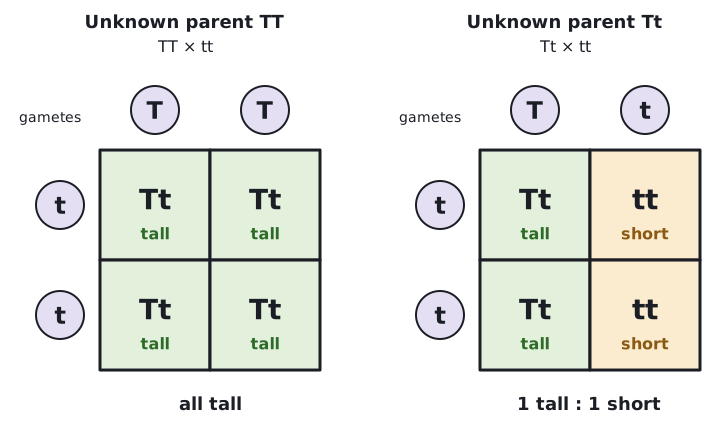
Two Punnett squares for a test cross with tt: if the unknown parent is TT all four offspring are Tt (all tall); if the unknown parent is Tt the offspring are Tt, tt, Tt and tt (1 tall : 1 short). (opens full size in a new tab)
A test cross with a homozygous recessive (tt) plant: any short offspring show that the unknown parent is heterozygous.
Exam tip:

The tester is always homozygous recessive, because its phenotype tells you its genotype. Say that the offspring show whether the unknown parent has a recessive allele.

Written and checked against the Cambridge IGCSE Biology (0610) specification · Updated October 2026

Frequently asked questions

What is a genotype and phenotype?

A genotype is the genetic make-up of an organism in terms of the alleles present, such as Tt. A phenotype is the observable features of an organism, such as being tall. A heterozygous Tt pea plant has the tall phenotype, because the dominant allele T is expressed even though a recessive allele is present.

What is a Punnett square used for in genetics?

A Punnett square is used to show the possible offspring of a genetic cross. The gametes of one parent go along the top and the other along the side, and the boxes show the possible offspring genotypes. From these you work out the phenotypes and the ratio, such as 3 : 1 or 1 : 1.

How do you find out if an organism is homozygous or heterozygous?

Supplement You use a test cross: cross the organism showing the dominant phenotype with a homozygous recessive individual. If any offspring show the recessive phenotype, the unknown parent must be heterozygous. If all the offspring show the dominant phenotype, it is probably homozygous dominant. A large number of offspring gives a more reliable result.

All 5 questions on Monohybrid inheritance