
Hydrophytes and xerophytesSpec 18.2.3
In short
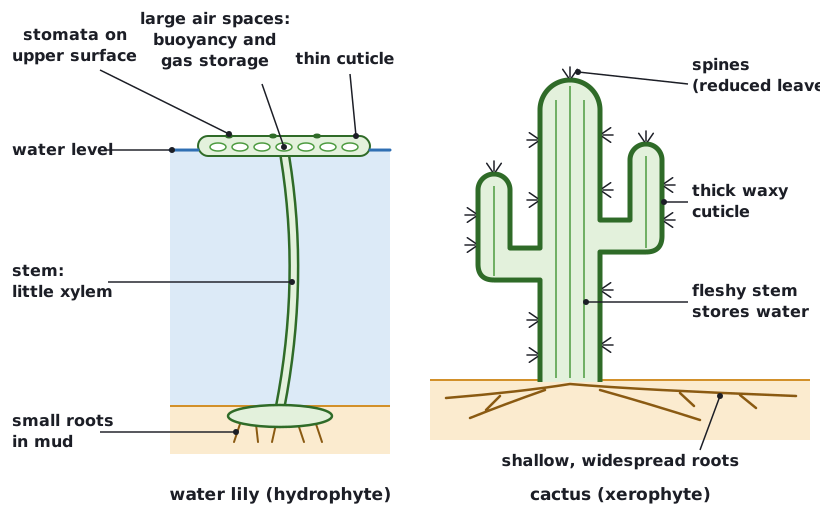
Hydrophytes are plants adapted to live in water, and xerophytes are plants adapted to dry places. A water lily has large air spaces so it floats, stomata on the upper leaf surface and a thin cuticle. Cactus and marram grass have a thick waxy cuticle, spines or rolled leaves, and sunken stomata that reduce water loss.
Hydrophytes are plants adapted to live in water or very wet places. Xerophytes are plants adapted to live in dry places where water is scarce.
Hydrophytes (for example the water lily)
| Feature | Explanation |
|---|---|
| Large air spaces in the leaves and stems | make the plant float so leaves are near the light; store oxygen and carbon dioxide for gas exchange |
| Stomata on the upper surface of floating leaves | the lower surface is in water, so the stomata on top can exchange gases with the air |
| Thin or no waxy cuticle | water is not scarce, so there is no need to prevent water loss |
| Small or reduced roots and little xylem | water can be absorbed over the whole surface and the water supports the plant |
Xerophytes (for example cactus and marram grass)
| Feature | Explanation |
|---|---|
| Thick waxy cuticle | reduces evaporation of water from the leaf surface |
| Leaves reduced to spines (cactus) | smaller surface area, so less water is lost by transpiration |
| Leaves rolled up with hairs (marram grass) | traps a layer of humid air next to the leaf, which reduces the concentration gradient of water vapour, so less water vapour diffuses out |
| Stomata in pits or sunken, few stomata | reduces diffusion of water vapour out of the leaf |
| Thick, fleshy stem (cactus) | stores water |
| Long roots or shallow, widespread roots | long roots reach water deep in the soil; widespread roots absorb rain water quickly over a large area |
 (opens full size in a new tab)
'Explain' means give a reason. For every feature say what it does and why that suits the environment, for example 'air spaces make the leaf float so it gets more light'.
Quick check
Define adaptive feature.
Show answer
An inherited feature that helps an organism to survive and reproduce in its environment.
Why is a skill learned during life not an adaptive feature?
Show answer
It is not inherited.
Supplement Where are the stomata on a floating water lily leaf?
Show answer
On the upper surface.
Supplement Why do xerophytes have a thick waxy cuticle?
Show answer
To reduce evaporation of water from the leaf surface.
Written and checked against the Cambridge IGCSE Biology (0610) specification · Updated October 2026