Book a tutor

Pyramids of energy

Organisms and their environment · Trophic levels and ecological pyramids · note 3 of 4

Spec 19.2.15, 19.2.16
Supplement (what this means)Supplement: only for the Extended papers (2 and 4). Core students can skip it. What the labels mean
Download all Trophic levels and ecological pyramids notes (PDF)Download all notes (PDF)6 pages

Pyramids of energySpec 19.2.15, 19.2.16

In short

A pyramid of energy shows the amount of energy that flows through each trophic level in a given area over a period of time, for example in kJ per m² per year. It is always pyramid-shaped, because energy is lost at each trophic level. It shows the rate of energy flow and allows transfer efficiency to be compared.

A pyramid of energy shows the amount of energy that flows through each trophic level in a given area over a period of time, for example in kJ per m² per year. It is drawn in the same way as the other pyramids, with the producers at the bottom and bars drawn to scale.

Example data for a pyramid of energy (practice values)
Trophic levelEnergy / kJ per m² per year
Producers10 000
Primary consumers1 000
Secondary consumers100
Tertiary consumers10
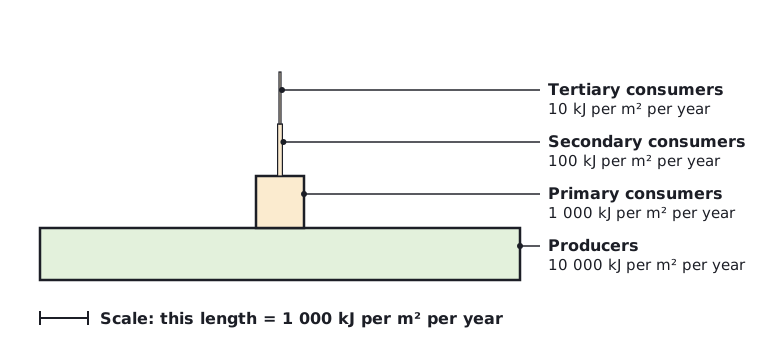
Pyramid of energy drawn to scale: producers 10 000, primary consumers 1 000, secondary consumers 100 and tertiary consumers 10 kJ per m² per year, with a scale bar for 1 000 kJ per m² per year. (opens full size in a new tab)
A pyramid of energy is always pyramid-shaped. In this example only a tenth of the energy passes on to each higher trophic level.

Advantages of a pyramid of energy

  • It is always pyramid-shaped, because energy is lost at each trophic level. It cannot be inverted.
  • It takes into account the size of the organisms, unlike a pyramid of numbers.
  • It shows the rate of energy flow, over a period of time. A pyramid of biomass shows only the mass at one moment (a pyramid of biomass can be inverted if organisms grow and reproduce quickly, for example algae in the sea).
  • Different tissues contain different amounts of energy per gram (fat contains more than carbohydrate), so equal biomass does not always mean equal energy. A pyramid of energy compares the energy directly.
  • It allows the efficiency of energy transfer between trophic levels to be compared.
Exam tip:

Write the units as energy per area per time, such as kJ per m² per year. A pyramid of energy never has an inverted shape.

Written and checked against the Cambridge IGCSE Biology (0610) specification · Updated October 2026

Frequently asked questions

Why is energy lost between trophic levels?

Supplement Energy is lost between trophic levels because not all of an organism is eaten, such as bones and roots, and some of what is eaten is not digested and is lost in faeces. Energy is also lost in excretion, such as urine. Respiration releases energy for movement and keeping warm, and much is lost as heat.

What is a pyramid of biomass?

A pyramid of biomass shows the mass of living material at each trophic level, for example in g per m², with the producers at the bottom and bars drawn to scale. It is usually pyramid-shaped, because there is less biomass at each higher level, and it is better than a pyramid of numbers because it accounts for organism size.

Why are food chains short?

Supplement Food chains are short because energy is lost at each trophic level, so less energy is available at each step. Energy is lost as heat from respiration, in faeces and urine, and in parts that are not eaten. By the fourth or fifth trophic level, there is too little energy left to support another population.

All 5 questions on Trophic levels and ecological pyramids