
Populations, communities and ecosystemsSpec 19.4.1, 19.4.2, 19.4.3, 19.4.4
In short
A population is a group of organisms of one species, living in the same area, at the same time. A community is all the populations of different species in an ecosystem, and an ecosystem is the community and its environment interacting together. The rate of population growth depends on food supply, competition, predation and disease.
- Population
- A group of organisms of one species, living in the same area, at the same time.
- Community
- All of the populations of different species in an ecosystem.
- Ecosystem
- A unit containing the community of organisms and their environment, interacting together.
| Level | Meaning | Pond example |
|---|---|---|
| Organism | A single living thing | One frog |
| Population | One species, in the same area, at the same time | All the frogs in the pond |
| Community | All the populations of different species in the ecosystem | All the plants, animals and microorganisms in the pond |
| Ecosystem | The community and its environment, interacting together | The pond community plus the water, light and temperature |
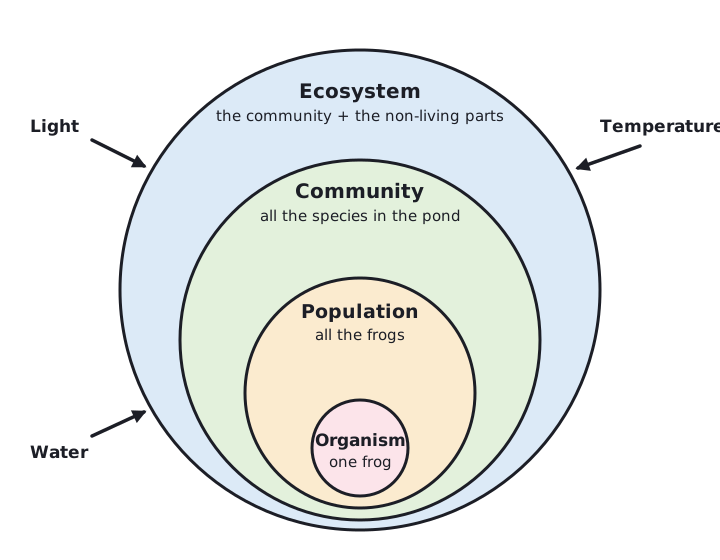 (opens full size in a new tab)
Factors affecting the rate of population growth
The rate at which a population grows depends on four factors: food supply, competition, predation and disease.
| Factor | Effect on population growth |
|---|---|
| Food supply | More food means more organisms survive and reproduce, so the population grows faster. Less food slows growth or makes the population fall. |
| Competition | Organisms compete for limited resources such as food, water, light and space. The more competition, the slower the growth. |
| Predation | Predators eat prey, so more predators slow the growth of the prey population. |
| Disease | Pathogens can kill or weaken organisms, so disease slows growth or reduces numbers. |
Common mistake:
A population is one species only. If an answer includes different species living together, it is describing a community. Always include 'at the same time' in the definition of a population.
Written and checked against the Cambridge IGCSE Biology (0610) specification · Updated October 2026