
GerminationSpec 16.3.8
In short
Germination is when a seed begins to grow into a new plant, and it needs water, oxygen and a suitable temperature. Water makes the seed swell and activates its enzymes, oxygen is needed for aerobic respiration, and enzymes work best at a suitable temperature. Light is not needed for most seeds, so investigation tubes are kept in the dark.
Germination is when a seed begins to grow into a new plant. A seed needs three conditions to germinate: water, oxygen and a suitable temperature. Light is not needed for most seeds to germinate.
| Condition | Why it is needed |
|---|---|
| Water | The seed absorbs water and swells, and its enzymes become active. The enzymes break down the stored food so it can be used for growth. |
| Oxygen | Needed for aerobic respiration, which releases energy for growth |
| Suitable temperature | Enzymes work best at a suitable temperature. Too cold and reactions are too slow; too hot and enzymes are denatured. |
Investigating the conditions needed for germination
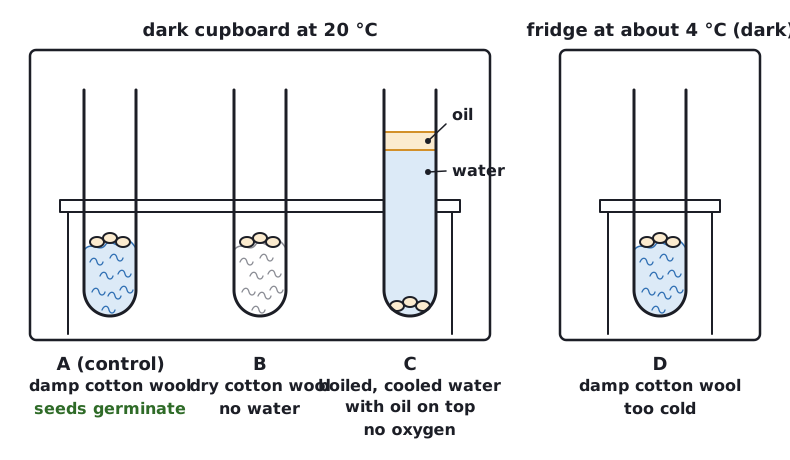
Set up several tubes with the same number of seeds and change one condition at a time. Tube A has all three conditions and is the control. Keep all the tubes in the dark (a fridge is dark inside), so that light is the same for every tube and is not a confounding variable.
| Tube | Water | Oxygen | Temperature and light | Expected result |
|---|---|---|---|---|
| A (control) | Damp cotton wool | Air present | 20 °C, dark cupboard | Seeds germinate |
| B | Dry cotton wool | Air present | 20 °C, dark cupboard | No germination: no water |
| C | Seeds covered with boiled, cooled water and a layer of oil | Little or none: boiling removes dissolved oxygen, and the oil stops air entering | 20 °C, dark cupboard | No germination: no oxygen |
| D | Damp cotton wool | Air present | Fridge, about 4 °C (dark) | No germination: too cold |
 (opens full size in a new tab)
Keep every other variable the same: same type and number of seeds, same volume of water, same light (all in the dark) and same time. Leave the tubes for several days and count the seeds that have germinated in each. Using more seeds per tube makes the result more reliable.
Say what each tube shows by comparing it with the control. Only one condition should differ between the control and each other tube.
Quick check
Which part of a flower makes pollen?
Show answer
The anther.
Define pollination.
Show answer
The transfer of pollen grains from an anther to a stigma.
Give two features of wind-pollinated pollen grains.
Show answer
Small and light; smooth surface.
What three conditions does a seed need to germinate?
Show answer
Water, oxygen and a suitable temperature.
Supplement Define cross-pollination.
Show answer
The transfer of pollen grains from the anther of a flower to the stigma of a flower on a different plant of the same species.
Written and checked against the Cambridge IGCSE Biology (0610) specification · Updated October 2026