
Villi and microvilliSpec 7.5.3, 7.5.4, 7.5.5
In short
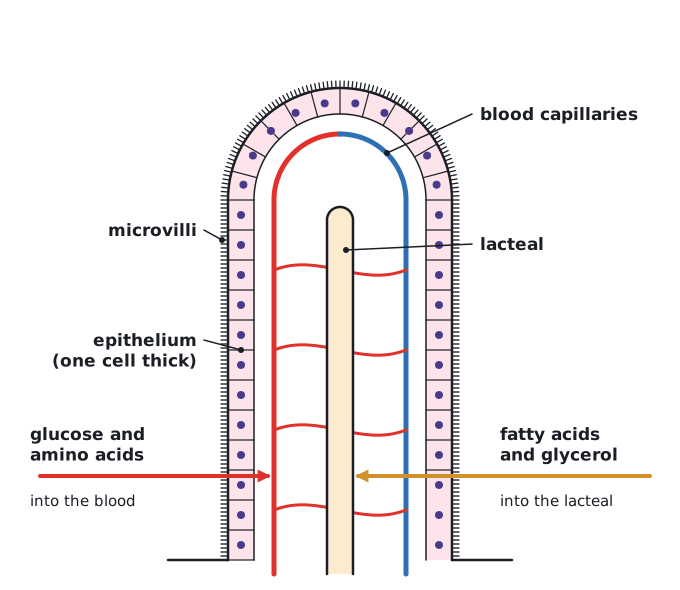
Villi are tiny finger-like projections lining the small intestine, and the cells on their surface have even smaller projections called microvilli. Together they greatly increase the internal surface area for absorption. Each villus has a wall one cell thick, a network of capillaries that absorb glucose and amino acids, and a lacteal that absorbs fatty acids and glycerol.
The inside of the small intestine is covered in tiny finger-like projections called villi (singular: villus). The cells on the surface of each villus have even smaller projections called microvilli.
Villi and microvilli greatly increase the internal surface area of the small intestine. A larger surface area means more nutrients can be absorbed into the blood in a given time.
Structure of a villus
- The wall is a single layer of epithelial cells, so the distance for nutrients to travel is short.
- The epithelial cells have microvilli, which increase the surface area further.
- Inside the villus there is a network of capillaries and a lacteal.
 (opens full size in a new tab)
Roles of capillaries and lacteals
| Structure | Role |
|---|---|
| Capillaries | Absorb glucose and amino acids (and other nutrients) into the blood; the flowing blood carries them away, which keeps absorption going |
| Lacteal | A lymph vessel in the centre of the villus that absorbs fatty acids and glycerol and carries them away in the lymph |
For a 'how is a villus adapted' question: large surface area (villi and microvilli), thin wall (one cell thick) and a good blood supply (capillaries). Always link the feature to absorption.
Quick check
Where are nutrients absorbed?
Show answer
The small intestine.
Where is most water absorbed?
Show answer
The small intestine (some is absorbed in the colon).
Supplement What is the role of villi and microvilli?
Show answer
They increase the internal surface area of the small intestine.
Supplement What does the lacteal absorb?
Show answer
Fatty acids and glycerol.
Written and checked against the Cambridge IGCSE Biology (0610) specification · Updated October 2026