
Book a tutor

Trophic levels

Organisms and their environment · Trophic levels and ecological pyramids · note 1 of 4

Trophic levelsSpec 19.2.13, 19.2.14

In short

A trophic level is the position of an organism in a food chain, food web or ecological pyramid. Producers are trophic level 1, primary consumers level 2, secondary consumers level 3, tertiary consumers level 4 and quaternary consumers level 5. An organism in a food web can be at more than one trophic level, depending on what it eats.

Trophic level
The position of an organism in a food chain, food web or ecological pyramid.

Trophic levels are numbered from the producer at the start of the chain. The same names are used in food webs, food chains and ecological pyramids.

Trophic levels
Trophic levelNameExample
1ProducersGrass
2Primary consumersGrasshopper
3Secondary consumersFrog
4Tertiary consumersSnake
5Quaternary consumersEagle

An organism in a food web may be at more than one trophic level. For example, an animal that eats both plants and herbivores is a primary consumer in one food chain and a secondary consumer in another. Decomposers feed on the dead remains from every trophic level.
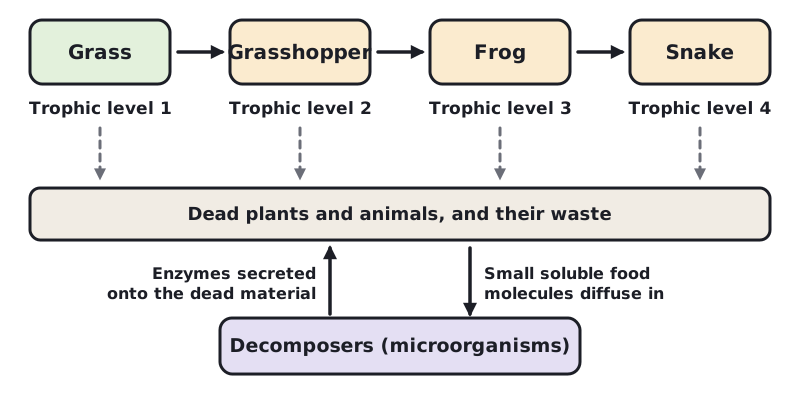
Food chain of grass, grasshopper, frog and snake labelled trophic levels 1 to 4, with dashed arrows from each to dead plants and animals and their waste; below, decomposers (microorganisms) feed on the dead material. (opens full size in a new tab)
Every trophic level ends up as dead material or waste, which decomposers feed on.
Common mistake:

Producers are trophic level 1, so the primary consumer is level 2 and the secondary consumer is level 3. Do not count from the first animal.

Written and checked against the Cambridge IGCSE Biology (0610) specification · Updated October 2026

Frequently asked questions

Why is energy lost between trophic levels?

Supplement Energy is lost between trophic levels because not all of an organism is eaten, such as bones and roots, and some of what is eaten is not digested and is lost in faeces. Energy is also lost in excretion, such as urine. Respiration releases energy for movement and keeping warm, and much is lost as heat.

What is a pyramid of biomass?

A pyramid of biomass shows the mass of living material at each trophic level, for example in g per m², with the producers at the bottom and bars drawn to scale. It is usually pyramid-shaped, because there is less biomass at each higher level, and it is better than a pyramid of numbers because it accounts for organism size.

Why are food chains short?

Supplement Food chains are short because energy is lost at each trophic level, so less energy is available at each step. Energy is lost as heat from respiration, in faeces and urine, and in parts that are not eaten. By the fourth or fifth trophic level, there is too little energy left to support another population.

All 5 questions on Trophic levels and ecological pyramids