
Gas exchange in light and dark: hydrogencarbonate indicatorSpec 6.1.9
In short
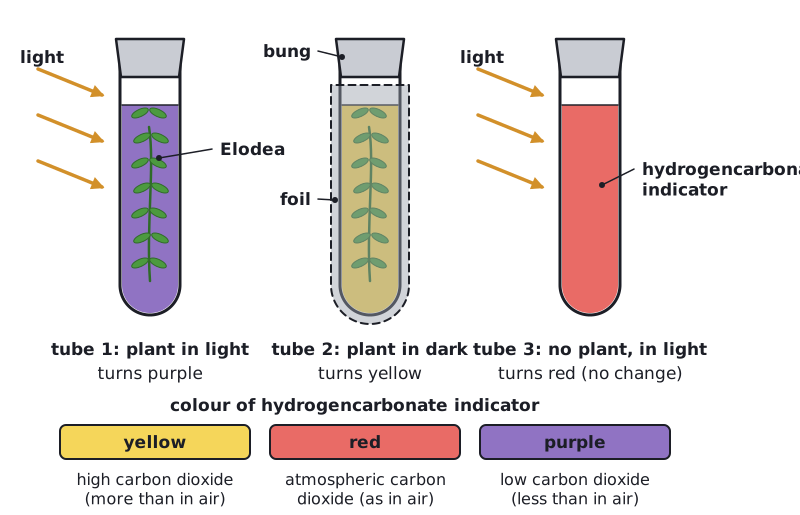
Hydrogencarbonate indicator is a solution that changes colour with carbon dioxide concentration: yellow when high, red at atmospheric level and purple when low. An aquatic plant in bright light turns it purple because photosynthesis uses carbon dioxide faster than respiration releases it. In the dark the plant only respires, so the indicator turns yellow.
Hydrogencarbonate indicator solution changes colour with the concentration of carbon dioxide in the solution. It is used to show whether an aquatic plant is taking in or giving out carbon dioxide.
| Colour | Carbon dioxide concentration |
|---|---|
| Yellow | High (more than in air) |
| Red | Same as in the air (atmospheric level) |
| Purple | Low (less than in air) |
Method
- Set up three boiling tubes, each with the same volume of hydrogencarbonate indicator solution. The indicator starts red.
- Put a similar piece of aquatic plant (for example Elodea) in tube 1 and place it in bright light.
- Put an identical piece of plant in tube 2 and wrap the tube in foil so that it is in the dark.
- Leave tube 3 with no plant in the light as a control.
- Seal the tubes with bungs and leave for a few hours, then record the colour of each.
| Tube | Final colour | Explanation |
|---|---|---|
| 1: plant in light | Purple | Photosynthesis uses carbon dioxide faster than respiration releases it, so the carbon dioxide concentration falls |
| 2: plant in dark | Yellow | There is no photosynthesis. The plant respires and releases carbon dioxide, so the concentration rises |
| 3: no plant (control) | Red (no change) | Shows that the colour change in the other tubes is due to the plant |
Plants respire all the time, in the light and in the dark. In the light, photosynthesis is faster than respiration, so there is a net uptake of carbon dioxide. If light is dim, the two rates may be equal and the indicator stays red.
The control tube with no plant is essential, because it shows the indicator does not change colour on its own. Keep the volume of indicator, the size of the plant and the time the same in every tube.
 (opens full size in a new tab)
Quick check
Give the word equation for photosynthesis.
Show answer
Carbon dioxide + water → glucose + oxygen, in the presence of light and chlorophyll.
Which carbohydrate is transported in the phloem?
Show answer
Sucrose.
Why do plants need magnesium ions?
Show answer
To make chlorophyll.
What colour does iodine solution turn in the presence of starch?
Show answer
Blue-black.
Supplement Write the balanced chemical equation for photosynthesis.
Show answer
6CO₂ + 6H₂O → C₆H₁₂O₆ + 6O₂
Written and checked against the Cambridge IGCSE Biology (0610) specification · Updated October 2026